
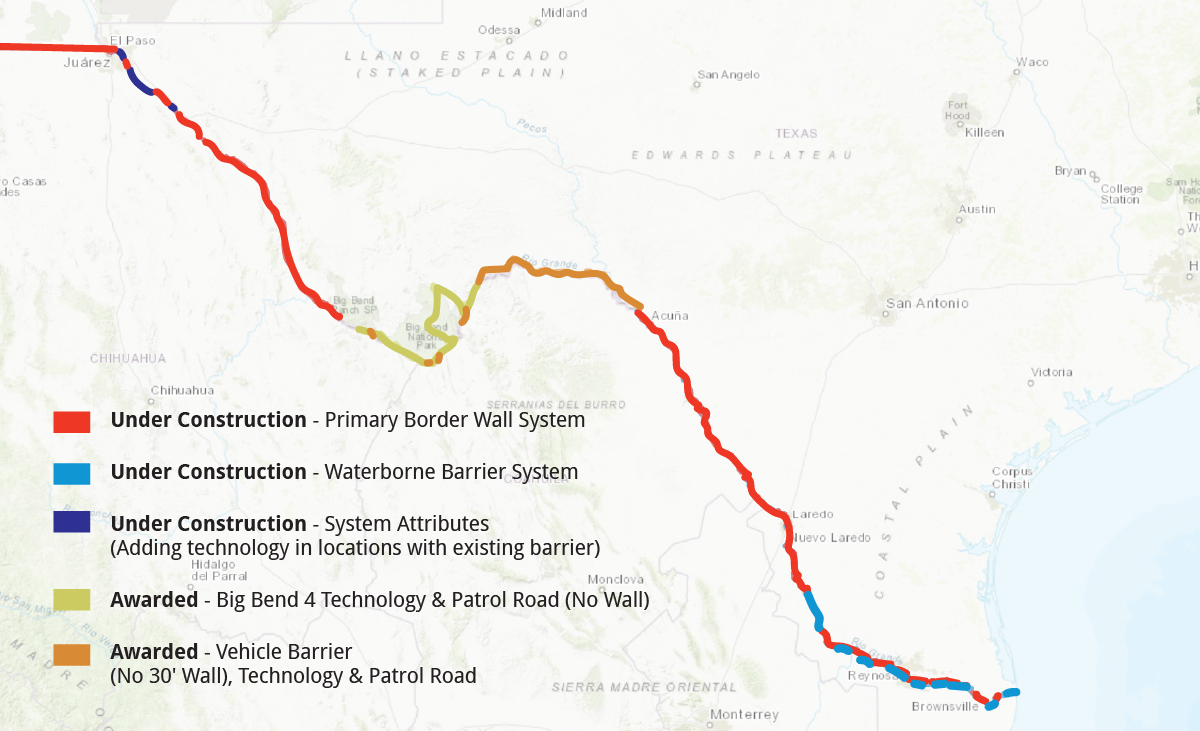
About the Project
In July of 2025, the US signed the “Big Beautiful Bill” into law which appropriated $46.5 billion to complete hundreds of miles of new and replacement primary walls, secondary walls and water/river barriers along the US and Mexico border, with completion of primary targets scheduled through late 2027.
To streamline the process, in 2025, the US Department of Homeland Security (DHS) issued a series of waivers under Section 102 of the Illegal Immigration Reform and Immigrant Responsibility Act (IIRIRA) to accelerate border barrier and road construction across the US–Mexico border. These included waivers of environmental and cultural protections and, most notably, most federal contracting oversight protections removing public notice, competitive bidding and small business obligations.
Border Wall Infrastructure
Generally, the wall consists of a series of steel bollards set in a concrete foundation ranging in height from 18 to 30 feet. 20- to 40-foot gates are located along the route allowing access to property on both sides of the wall. The gates are operated by keypad entry with the landowner possessing the gate code and the right to share the code with others subject to certain reporting requirements. The wall is designed with lights, sensors and other detection devices as shown here. Further, 24-foot patrol roads and 12-foot maintenance roads are typically constructed adjacent to the wall.
Condemnation Process
Condemnation is the federal government’s exercise of its power of eminent domain under the 5th amendment of the US Constitution: “nor shall private property be taken for public use, without just compensation. “A condemnor in the US, for instance, may acquire private property for public use such as parks, schools, roads and other infrastructure including the border wall.
Compensation
Landowners are entitled to just compensation when a condemnor takes their property. Compensation is based on fair market value (willing buyer/willing seller rule). Although a landowner has the constitutional right to be compensated for the property interest acquired and its impact on the value of their land, the condemnor may proceed with the taking even if the landowner does not agree to the acquisition or the compensation offered.
The amount of compensation depends on the property interest being acquired and the property’s highest and best use. Under federal law, the compensation essentially consists of the difference between two appraisals, the fair market value of the whole property before the taking and fair market value of the property after the taking. The after taking includes analysis of the taking and its impact on value (remainder damages).
Additional Resources
- Landowners Reference Guide and Gate Information
- About the Border Wall Condemnation and Compensation Process
- SCOTUSblog: Mullin v. Friends of the Ruidosa Church
Related Blogs
- November 3, 2026 – Federal Judge Halts Big Bend Border Wall Construction in Texas
- May 1, 2026 – Barron Adler Partner Roy Brandys Discusses Border Wall Eminent Domain Strongarming Tactics with Texas Observer
- March 10, 2026 – Ongoing Texas Border Wall Development Keeps Landowners in Limbo
- October 27, 2025 – Eminent Domain Returns to the Rio Grande: What the Federal Border Wall Project Means for Texas Landowners
To speak to an experienced eminent domain and condemnation attorney about the Federal Border Wall project, call Barron, Adler, Clough & Oddo, PLLC at (512) 478-4995 or fill out the contact form on the right side of this page.